
Day 86- The Rabbit Problem
PAWS #100DayPictureBook Challenge - Read, Learn, Write, Create

Age Group: 4-8 Years
Author: Emily Gravett
Illustrator: Emily Gravett
Publisher: Simon & Schuster Books for Young Readers
No. of Pages: 32
Type: Picture Book
Binding: Hardcover
Size: 27.94 x 1.27 x 22.86 cm
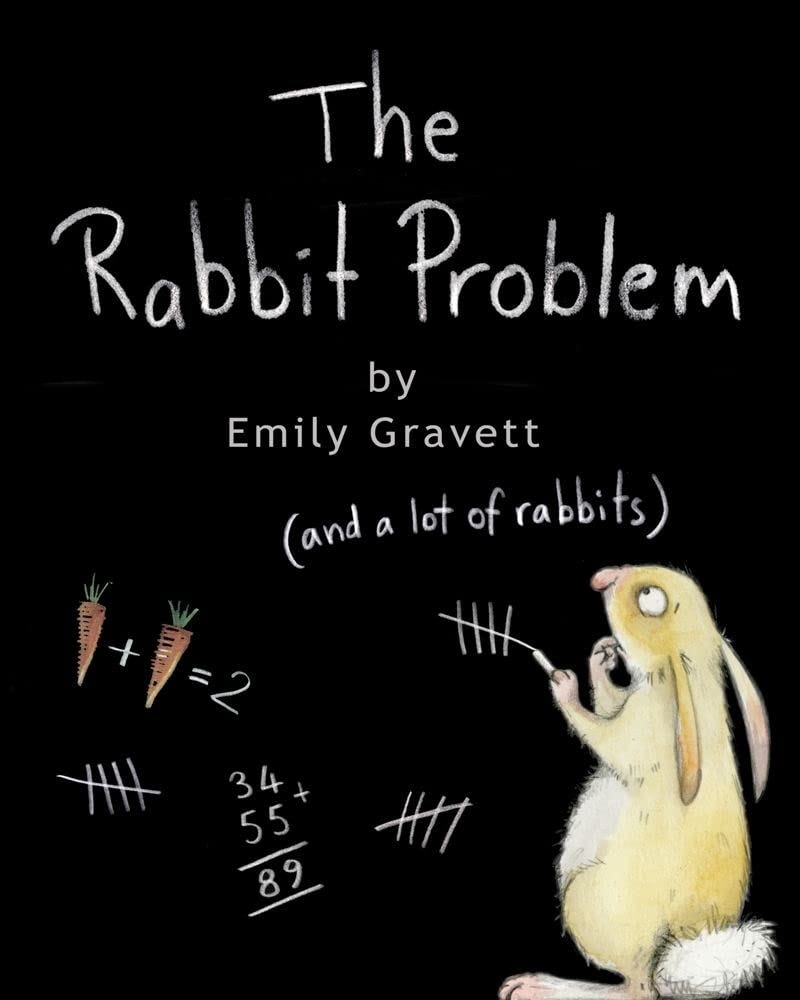
How does 1+1 = 288? A family of rabbits soon supplies the answer in this funny story! Hop along to Fibonacci's Field and follow Lonely and Chalk Rabbit through a year as they try to cope with their fast expanding brood and handle a different seasonal challenge each month, from the cold of February to the wet of April and the heat of July. This extraordinary picture book is packed with gorgeous details and novelty elements including a baby rabbit record book, a carrot recipe book and a surprise pop-up ending.
Review
"In Gravett’s gifted hands, an old math problem springs to life—and more life and more life! Medieval mathematician Fibonacci’s “rabbit problem,” in which bunnies breed at a specified rate, provides the structure of this glorious faux–wall calendar that watches a rabbit community from January to December...Readers needn’t care about the math of Fibonacci Numbers to love the hilarious, jam-packed visual details, many of which are playfully metatextual...Endless fun to pore over for kids and math-minded or geeky adults.--Kirkus Reviews, starred review
Critique by Dr.Lynda Colgan
Gravett explores many mathematical ideas in this book, including: counting, calendar math, temperature and measurement. All of these topics would be excellent fodder for a primary lesson. Gravett also provides a starting point for a class to explore number patterns in general and the Fibonacci sequence in particular. Fibonacci first described his ‘famous’ number sequence as the solution to a math problem: If a pair of rabbits are put together under certain conditions (“NO Rabbits may leave the field”), how many will there be in one year? This puzzle, posed by Fibonacci in the 13th-century, is the premise for Gravett's book. Using lively illustrations Gravett explores one of the most unique number sequences of all times.
Accuracy/Mathematical Integrity: Gravett’s presentation of Fibonacci’s Rabbit Problem and the subsequent sequence is accurate. She provides help for the viewer by providing a sign at the top of each page to indicate the number of rabbits each month. The tone of this book is exceptionally light and playful. All in all, Gravett presents Fibonacci’s Rabbit Problem in an approachable and entertaining manner.
Visual and Verbal Appeal: Gravett is known for her illustrations. Her whimsical drawings are beautifully rendered in graceful watercolor and ink. There is so much going on for children to explore. Particularly of note is her book within a book conceptualization. As always, Gravett's design choices are perfect for enhancing the narrative. Viewers can turn the book lengthwise and watch the e f f e c t s o f t h e e v e r - multiplying bunnies in watercolor scenes on the top, while the hand-notes and novelty items glued to the dates below reveal seasonal challenges. In March, while the stressed parents learn infant care, a baby book showcases a tiny ultrasound of the twins. July depicts bored bunnies watching carrots grow. A miniature newspaper (The F i b b e r ) i n c l u d e s biographical information on the famous mathematician, personals, birth announcements, graphs, and horoscopes. Under an empty, snow-covered field and through the die-cut hole that follows December 31, a peek and a page turn reveal the population explosion leaping, literally, off the page in a sturdy pop-up spread.
Connections: This book works on so many different levels. On one level it contextualizes everyday math concepts: calendar math, temperature, measurement etc. On another level, it recreates a math problem and number sequence dating back to the 13th century. To help her audience Gravett even provides information about Fibonacci in one of the smaller books enclosed within the main story. Gravett does a clever job of creating an enchanting story that readers can connect with. Who knew a 13th century number sequence could be so much fun?
“Wow” Factor: This extraordinary picture book is packed with gorgeous details and novelty elements including a baby rabbit record book, a carrot recipe book and a surprise pop-up ending. The Rabbit Problem is brilliantly packaged. Laid out in a calendar format, the pages provide a clever backdrop for the story of a rabbit named Lonely, who sends out invitations in January looking for a friend. Gravett’s ‘tongue and cheek’ portrayal of Fibonacci’s problem makes this book a worthwhile read for all ages.
Criticisms: A couple of very small ones. To be unnecessarily pedantic, it ignores the issue of dying rabbits from the calculations of Fibonacci numbers. But then Fibonacci’s Rabbit Problem is hypothetical and we all know that rabbits do not breed this way. Aesthetically, it's perfect, and bears looking at time and again. Still, I would have liked a slightly stronger narrative, to give it a bit more depth - perhaps another edition of the newspaper, or a rabbit's diary may have helped. One other suggestion would be for Gravett to make the connections of Fibonacci’s sequence to nature more explicit. Creating rabbits that were in a field of sunflowers, picking nautilus shells off a beach or eating a pineapple would add yet another intriguing layer.
Questions for the Picture Book Creator from “The Rabbit Problem”
How can the format of my book (calendar, diary, map, etc.) become part of the storytelling itself? The book’s physical form can matter.
Can I blend fiction with learning so readers absorb a concept while enjoying the story? Here, Fibonacci Sequence and population growth are taught through humor.
Where can I use humor to make abstract or serious ideas more engaging? Each rabbit problem is funny and relatable.
How might I add interactive elements (letters, charts, flaps, or surprises) to increase re-readability? Books can be a tactile, playful experience.
In what ways can my illustrations mirror the story’s arc, building tension or chaos visually? Illustrations convey mood, pacing and tension.
How can I use scale, repetition and variation to create rhythm without becoming boring? Here, rabbit forms created rhythm.
Could my book work with a problem-solution structure instead of a traditional narrative arc?
Writing Prompts (Choose One)
✍️ 1. One becomes many: Write a story where a single small thing (seed, idea, or creature) multiplies until it changes everything.
✍️ 2. A problem every month: Imagine a character facing a new “problem” each month of the year. What happens by December?
✍️ 3. The crowded diary: Tell a story as if it’s someone’s journal, but each entry gets busier and busier.
Illustration Prompts (Choose One)
🎨 1. Growing too big: Draw something that starts small but grows so large it overflows the page.
🎨 2. Too many to count: Draw one simple object repeated so many times that the picture feels crowded, funny, or chaotic.
🎨 3. Problem pile-up: Draw a character surrounded by too many versions of the same thing (too many pants, plums, or pets).
Happy Creating!